Audiogram Best Practices for Social Media in 2026
Audiogram best practices for social media: clip length, captions, platform formats, posting times and CTAs that help podcast clips perform.
Quick Answer
The best audiograms for social media are short, captioned, visually clean, and built around one strong moment. If the clip does not hook attention in the first few seconds, match the platform format, and clearly point viewers to the next step, it usually underperforms.
Audiograms work best when you treat them as promotional assets, not full episode replacements.
Why audiograms still work
Audiograms help audio content compete in visual feeds. A plain podcast clip is easy to miss on Instagram, LinkedIn, X, TikTok, or Shorts. An audiogram adds motion, captions, branding, and a clearer reason to stop scrolling.
That makes audiograms especially useful when:
- You want to promote a podcast episode
- You need a lightweight social asset from audio-first content
- You want to publish consistently without recording face-first video every time
- You need a reusable format for quotes, highlights, or teaser moments
Audiograms are not always the highest-performing format on every platform, but they are still one of the easiest ways to turn spoken content into something social-ready.
If you are still deciding which tool to use before optimizing the clip itself, start with Best Audiogram Maker Tools for Podcasters.
Audiogram best practices for social media
1. Choose a clip with a real hook
The clip matters more than the waveform.
Pick a moment that creates immediate curiosity, tension, surprise, emotion, or clarity. Good audiogram moments usually sound like:
- A strong opinion
- A surprising stat or insight
- A useful takeaway
- A quote people want to share
- A moment that makes the listener want the rest of the conversation
Avoid clips that need too much setup. If people need 20 seconds of context before the point becomes clear, the clip is usually too slow for social.
2. Keep the length tight
For most platforms, shorter is better. A strong audiogram usually lands in the 15 to 45 second range.
Use longer clips only when:
- The payoff comes quickly
- The topic needs a little more context
- You are posting on a platform where viewers accept slightly longer watch times
If you are unsure, cut two versions and compare performance instead of guessing.
3. Make captions non-negotiable
Many people watch social content with the sound off. That means captions are not optional.
Your captions should be:
- Large enough to read on mobile
- Timed accurately
- High contrast against the background
- Broken into readable phrases instead of long blocks
Clean captions do two jobs at once: they improve accessibility, and they improve retention.
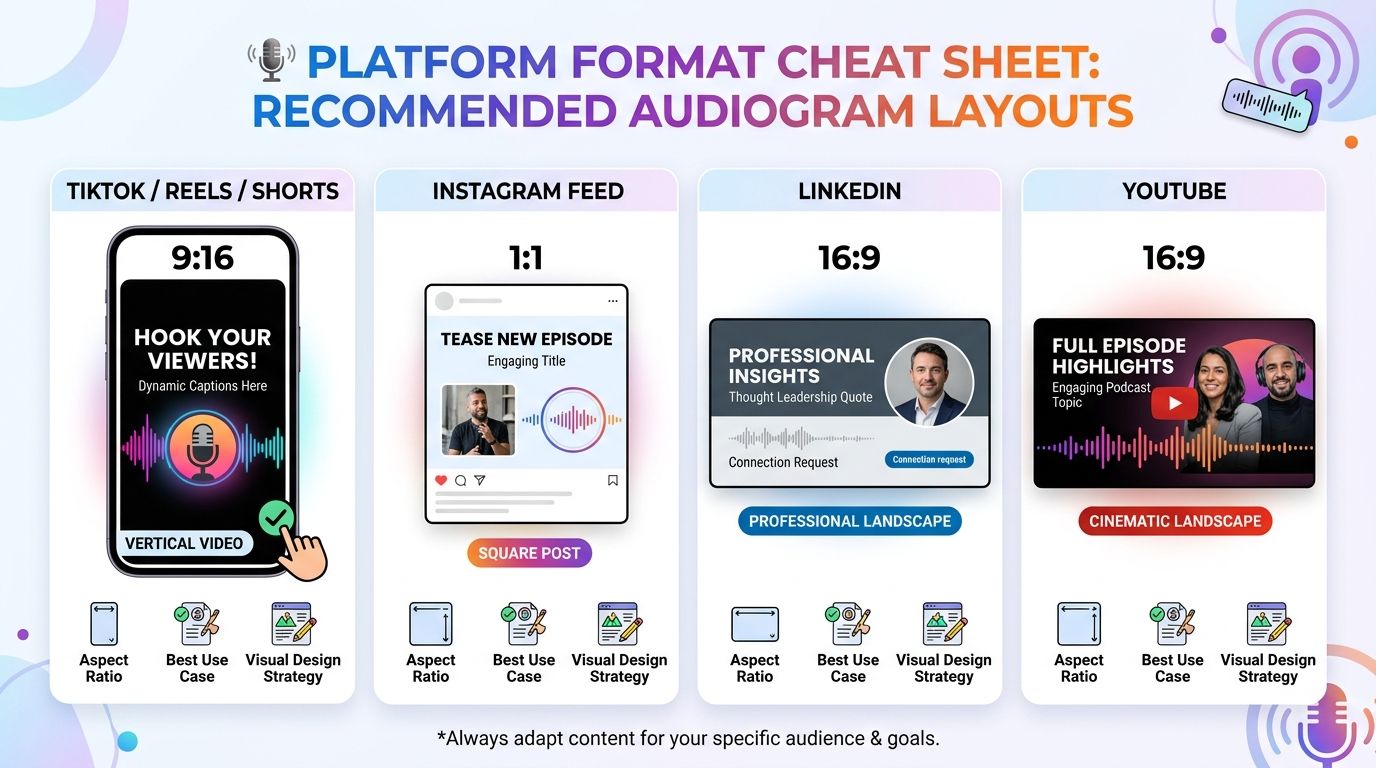
4. Match the format to the channel
Audiograms should look native to the platform where they are posted.
- Use vertical formats for TikTok, Reels, and Shorts.
- Use square or vertical formats for Instagram feed posts.
- Use square, vertical, or landscape depending on the LinkedIn layout you prefer to test.
- Avoid uploading one layout everywhere without checking how it crops.
If the format feels off, people notice immediately, even before they process the content.
5. Keep the design simple
An audiogram should support the audio, not distract from it.
Use:
- One readable headline or title
- Clean waveform animation
- Limited on-screen elements
- Consistent brand colors and fonts
- A subtle logo or show mark if useful
Do not overload the frame with too much text, too many stickers, or competing motion. Clarity wins.
6. Add a clear CTA
Every audiogram should answer the question: what should the viewer do next?
Depending on the platform, that might be:
- Listen to the full episode
- Watch the full video
- Follow for more clips
- Visit the link in bio
- Comment for the full resource
Keep the CTA short and specific. Weak endings reduce the value of even a strong clip.
Posting strategy that helps audiograms perform
Creating the asset is only half the job. Distribution matters just as much.
Write supporting caption copy
Your post text should give the clip a reason to matter. A good caption can:
- Add missing context
- Highlight the takeaway
- Set up the question the clip answers
- Give the viewer a reason to engage
The audiogram and the post copy should work together, not compete with each other.
Publish by channel goal
Not every platform serves the same job.
- Use discovery channels for reach and awareness.
- Use LinkedIn or email for more context and conversion intent.
- Use blog and show notes pages for search-friendly depth.
That means the same clip can be packaged differently depending on whether your goal is reach, traffic, or listener conversion. It also means the workflow should not stop at export. If your team can post or schedule directly to social from the same tool, you remove one of the easiest places for content to stall after editing.
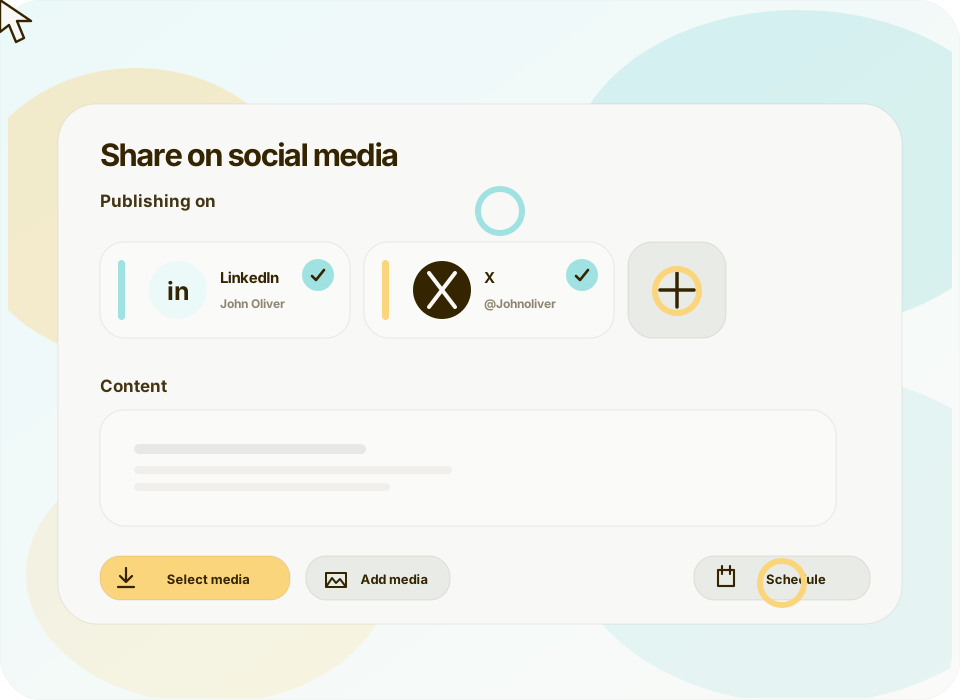
The operational benefit is simple: fewer handoffs between editing, exporting, uploading, and scheduling usually means more clips actually get published.
Reuse strong clips intelligently
You do not need to invent a brand-new audiogram every day.
You can:
- Repost top performers later
- Test the same clip with a different hook line
- Change the format for a different platform
- Pull multiple short clips from one longer episode
That is usually a better use of time than constantly making brand-new weak assets.
Common audiogram mistakes
- Choosing clips that take too long to get interesting
- Using subtitles that are too small for mobile
- Posting horizontal formats on vertical-first channels
- Treating every platform the same
- Over-designing the frame
- Forgetting the CTA
- Measuring output volume instead of actual engagement
What to measure
If you want audiograms to improve your podcast growth, track more than views.
Watch:
- Average watch time or retention
- Completion rate
- Saves, shares, and comments
- Click-through rate to the full episode or landing page
- Follower growth from repeat clip publishing
The best audiogram is not the prettiest one. It is the one that earns attention and moves people to the next step.
If your workflow is growing beyond one social asset and into broader clip, caption, and post-production reuse, compare that bigger tool category in Best AI Content Repurposing Tools.
How Recast Studio helps
Recast Studio fits this workflow well because it is built for turning podcast and audio content into social-ready assets faster.
Recast helps with:
- Audiogram creation from podcast clips
- Automatic captions
- Format resizing for social platforms
- Templates for branded exports
- Direct posting or scheduling to connected social platforms
- Broader repurposing support like clips, show notes, blog posts, and social copy from the same source recording
That matters if your workflow is bigger than one clip at a time. Instead of creating an audiogram in isolation, you can turn one episode into a batch of reusable outputs and keep distribution moving without exporting and re-uploading everything into a separate scheduling tool.
FAQ
How long should an audiogram be for social media?
Start in the 15 to 45 second range. Short enough to keep attention, long enough to deliver one useful or intriguing moment.
Do audiograms still work in 2026?
Yes, especially for podcast promotion, quote clips, and audio-first brands. They are not the only format you should use, but they are still a practical social asset when built well.
What is the most important part of an audiogram?
The clip selection. A great design cannot rescue a weak moment with no hook.
Should I use audiograms or video clips with faces?
If you have strong face-first video, that often performs better on many social platforms. Audiograms are especially useful when your source is audio-first, remote, or not visually interesting enough to publish as raw video.
Next Step
If you already have podcast or audio content ready, test a short clip in Recast’s Podcast Audiogram Generator and compare two hook variations instead of publishing just one version.